
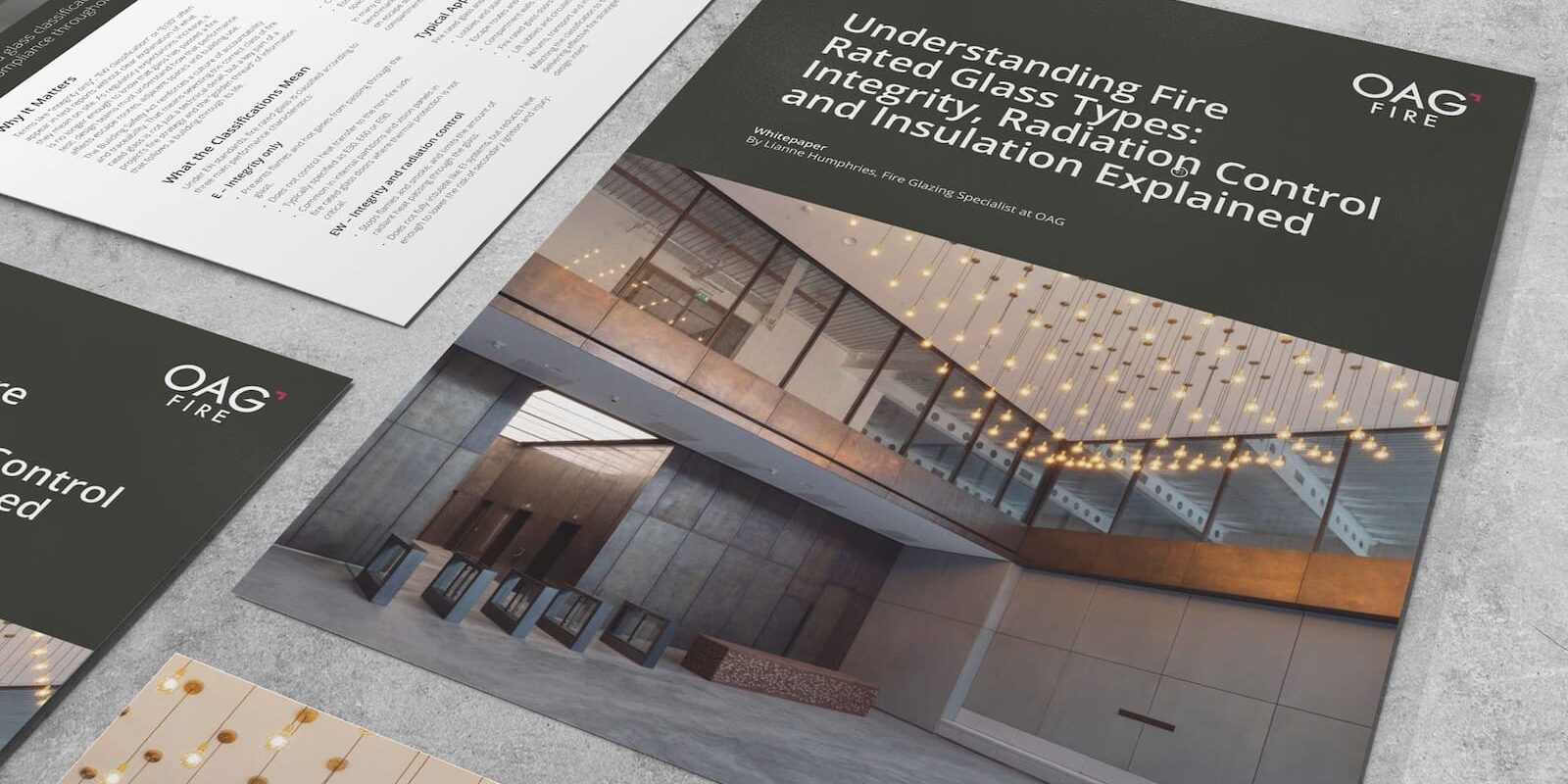
Fire rated glass types explained: understanding E, EW and EI in modern specification.
Specifying fire rated glass is no longer just about choosing a time rating. As UK projects move towards EN classifications and the Building Safety Act places greater emphasis on evidence, traceability and accountability, architects and contractors need a clearer understanding of how fire rated glass performs in practice. Our latest whitepaper explains the difference between E, EW and EI classifications, why heat transfer matters and how to specify complete tested systems with confidence.
Why understanding fire classifications matters
Terms such as integrity only, radiation control and insulation appear regularly in fire strategy discussions, but they are often misunderstood during specification. Choosing the right class of fire rated glass affects far more than compliance — it directly influences escape route protection, occupant safety and how well a compartmentation strategy performs in real-world conditions.
What E, EW and EI actually mean
Under EN standards, fire rated glass is classified by how it performs against flames, smoke and heat. E-rated glass provides integrity only, meaning it prevents flames and hot gases from passing through but does not control heat transfer. EW-rated glass adds radiation control, helping reduce radiant heat. EI-rated glass provides both integrity and insulation, limiting temperature rise on the non-fire side and offering the highest level of protection. In many projects, EI30 and EI60 are now the benchmark for escape routes and other critical areas.
Why heat transfer matters as much as flame containment
A glazed screen can remain intact during a fire, but that does not automatically mean the space on the other side is safe. Radiant heat can quickly make adjacent routes or rooms untenable, even when flames and smoke are contained. This is why understanding when EW is suitable and when EI30 or EI60 is required is so important in protected corridors, stair enclosures and other occupied escape routes.
The move from FD ratings to EN-classified systems
The industry is moving away from older shorthand such as FD30 and FD60 and towards EN-classified systems tested and classified under European standards. That shift brings greater clarity, but also places more responsibility on the specification team to ensure the entire assembly — including the glass, frame, seals, hardware and fixings — has been tested together. This is central to demonstrating compliance and maintaining the golden thread of information.
Choosing the right fire rated glass for the application
Good specification is not about using the highest rating everywhere. It is about matching the right classification to the location, risk and fire strategy. E glass may suit some internal screens or vision panels where thermal protection is not critical. EW glass may be appropriate where reduced radiant heat is needed. EI glass is typically required where adjacent spaces or escape routes must remain tenable. The key is early coordination and full-system evidence.
As fire safety regulation continues to evolve, understanding the difference between E, EW and EI is becoming essential for confident, evidence-based specification. Our whitepaper provides a practical guide to fire rated glass classifications, heat transfer and the importance of tested systems — helping design teams make informed decisions that support both safety and compliance. Download our whitepaper: “Understanding Fire Rated Glass Types: Integrity, Radiation Control and Insulation Explained.”
E, EW and EI Fire-Rated Glass FAQs
E means integrity only, so the glass prevents flames and hot gases from passing through. EW provides integrity plus radiation control, helping to reduce radiant heat. EI provides integrity and insulation, limiting temperature rise on the non-fire side and offering the highest level of protection.
Because stopping flames and smoke does not stop heat. In some applications, radiant heat can quickly make the non-fire side unsafe, even if the glass remains intact. That is why integrity-only glass is not suitable for every location.
EI glass is commonly required where escape routes, protected corridors, stair enclosures or adjacent occupied areas need to remain tenable during a fire. In many projects, EI30 and EI60 are used where both containment and insulation are essential.
EW glass provides integrity and limits radiant heat transfer, but it does not provide the full insulation performance of EI glass. It can be suitable where reduced heat radiation is needed but full insulation is not essential.
The market is increasingly moving towards EN-classified systems rather than older FD shorthand. Instead of relying on broad labels, design teams should look for complete systems classified as E, EW or EI under the relevant standards.
Because fire performance is not determined by the glass alone. The full assembly — including the frame, seals, hardware and fixings — must be tested together to show that it will perform as intended and to support compliance, traceability and the golden thread.